Labels

Sunday, July 20, 2014

Special Visit to the Xi'an Lama Temple

We visited the peaceful Lama Temple in Xi'an.  When we arrived our delegatation was welcomed by some of the monks and we were given white scarfs as a token of appreciation for our visit.


1,000 armed Avolokatsvara

A close up of the many extended arms/hands of the statue...

Lotus root and blossoms blooming all around...

Circumambulating the outside of the temple we spun the prayer wheels.

Tim lights a candle and places it on the altar.

We were invited to climb the steps to get a closer look at the upper portion of the giant Buddha statue.   First we had to put our feet in this silly machine to put a protective plastic cover over or shoes.

View from the top!

Amy from Portland and I sitting on the ornate couch in the temple masters private quarters.

Our group was given the rare opportunity to see the private area of the temple and we even had the pleasure of hearing the temple master chant a sutra.

This seat is reserved for the Pinchan Lama whenever he visits.

In this room was an old picture of Mao and the Dalai Lama before their falling out (to put it lightly)...

Fellow art educator and Chicago native, Margy, poses with the temple master.  She amazes me with her dedication to her craft; she is always sketching away in her sketchbook...everywhere we go.

As a sign of respect we tied our scarves on the door or a tree before we left.


Saturday, July 19, 2014

The Terra-cotta Army


This is a quote from Wikipedia that gives a brief synopsis of this amazing UNESCO world heritage site and archeological wonderland:

"The Terracotta Army or the "Terracotta Warriors and Horses" is a collection of terra cotta sculptures depicting the armies of Qin Shi Huang, the first Emperor of China.  It is a form of funerary art buried with the emperor in 210–209 BCE and whose purpose was to protect the emperor in his afterlife.

The figures, dating from approximately the late third century BCE, were discovered in 1974 by local farmers in Xi'an, Shaanxi province. The figures vary in height according to their roles, with the tallest being the generals. The figures include warriors, chariots and horses. Current (2007) estimates are that in the three pits containing the Terracotta Army there were more than 8,000 soldiers, 130 chariots with 520 horses, and 150 cavalry horses, the majority of which are still buried in the pits nearby the mausoleum. Other terracotta non-military figures were also found in other pits and they include officials, acrobats, strongmen, and musicians."


It is estimated that it took about 720,000 workers 38 years to complete the terra cotta warrior army for the tomb.  Upon completion the workers were buried alive at the site so that they couldn't share the secret location with anyone and risk an enemy ruining everything here.  A mere 4 years later, all of the artifacts were destroyed by his arch enemy. The state it is seen in today is after careful reconstruction and rearrangement of the army.  You can see how the army lay in ruins when it was originally excavated in some pits (see picture below).


The different hairstyles represented different ranks in the army...

Horses leading the chaatiots...

A photo showing the original pink hue of the terra-cotta.

The kneeling warrior is one of the most well preserved pieces where paint and details still remain in some areas.

Look at the detailed texture on the soles of the shoe!

There is no more excavating of the site going on anymore, even though there is an entire pit unearthed. Instead they are focusing their efforts on trying to figure out a way to preserve the fragile paint that oxidizes immediately after excavation. In the picture above there is plastic wrapped around to protect the areas where some paint still remains.  The Chinese people are saving the rest of the burried army for future generations of archaeologists in hopes that there will be new advancements in preservation and restoration technology.


We visited a place close by that tries to recreate the same process in a variety of sizes of warrior statues.  We felt the smooth clay.

An artisan adds fine details to a small warrior with a metal clay tool.


Wednesday, July 16, 2014

Farmer Folk Paintings

During the cultural revolution in China, the intellectuals were cast out and sent to the countryside to work in the fields.  Many began to teach their artistry to the local peasants to pass the time.  Because the peasants were idolized as examples of the hard working everyday citizen of Mao's ideal of communist China, the folk paintings that came out of this time became popular.  Eventually individual stylized paintings and abstract touches started showing up. We visited the home of a folk artist and had the opportunity to see his process, his gallery in his home and many of us purchased some of his original paintings and prints to bring home with us!


His studio table with his materIals...

Our guide, Tiger, explains to us that this artist studied under the man who created the drawing of Mao Zedong that is used on the Chinese Yuan currency.

A small and quick first sketch...

Under drawing...

A print of the finished piece

This one shows people bringing bundles of lanterns, in the snow, for the New Year celebration.


Traditional Chinese Medicine: Acupuncture Experience


We visited a university in Xi'an called Shanxi University of Chinese Medicine.  We attended a lecure where we learned about the history, theory and practice of TCM (Traditional Chinese Medicine).  We learned about acupuncture, moxibustion, and cupping.

After our lecture we visited the in site museum (you can see me posing in the picture above with a life size bronze statue that marks the meridians points used in the practice of acupuncture).  A similar model covered in wax is used by students in their final exams or "boards."

After that, we were brought to a hospital there where they practice TCM.  They called four 4 volunteers from the group and fellow fulbrighter Amy spoke up saying I should try it because of my neck/shoulder/ carpel tunnel issues associated with my birth defect.  My response?  Sure, why not?

The doctor began by pressing firmly in the area of my carpel tunnel and examining, massaging, and popping my neck as a sort of diagnostic exam.  Then came the needles!


I don't know if it was the hot room, exhaustion from the days previous activities, hunger, or my sensitivity to the acupuncture itself, but towards the end of the session the room started spinning, I felt naseous and felt sure I was going to faint.  Luckily the doctor, the local guide, and my group rushed to my side helping me onto the bed and giving me very hot water and I felt back to normal within minutes.  I think I nearly gave our scholar escort Harold a heart attack. After I came back to, I could see the look of relief in his eyes and he informed me that he had been contemplating if he needed to call our contact back home at the National Commitee in US-Chine Relations in the middle of the night about my predicament.


High Speed Train to Xi'an

We boarded a high speed bullet train from Beijing to Xi'an.  The trip that would normally take a around 18 hours on a regular train only took 5 1/2 on this speed train.

For the first half of the journey we passed countryside and many small cities popping up that show signs of the rapid growth of China with many cranes and tall buildings going up...

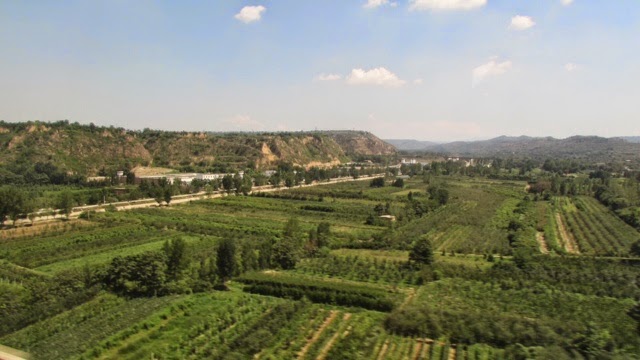
Lots of farm land...

A factory city?

As we got closer to our arrival to Xi'an the mountains began to make a debut in the passing landscapes.

Once we arrived in Xi'an we saw signs of a large city, but there was definitely a contrast between Xi'an and Beijing. The buildings here seemed to all look similar as opposed to the variety of architecture in Beijing.  Xi'an, being a smaller city in comparison, was also visibly cleaner.

The power lines were crazy!


Beijing Wrap Up


We are leaving Beijing and heading to Xi'an on a high speed bullet train.  The trip that would normally take around 18 hours on a regular train will only take us 5 1/2 hours on the faster train.

From my one week stay in China there seems to be an overarching theme of contagions.  I encounter them everywhere.  From the way the anicent and modern commingle in the subtleties of fashion, food, attitudes and more to the more obvious juxtaposition of the ancient buildings being enveloped by the swarms of looming skyscrapers in the urbanization of China.  This theme keeps coming up.  Many of the Chinese people seem to live two lives: a public life that is full of publicly acceptable comments, religious choices and feelings about the growing concern of human rights here and then a private life that they only feel truly comfortable talking about within the confines of their own homes or behind closed doors.  Also, environmental concerns and the issues surrounding global warming are apparent to all (no deniers here), yet the haze from the pollution is so strong you can't even see the sky most days.

Chinese culture is a complicated one to put it simply and obviously one that an American like me will never fully grasp with such a short history back home.  It is a true testament to the benefits of travel as opposed to just "reading about things in books" though, because I already feel Im have a much greater appreciation and understanding of Chinese people and their rich cultural heritage.

Here is a photo summary of my favorite pictures from Beijing...

animals representing the Chinese zodiac line the rooftops of a building while Chiristmas trees hover in the background.

I don't even know...

McDonald's has banana pies!

Fashion is everywhere...these shorts have mushroom characters with multiple eyes.

Bikes crowd the streets.  Perhaps because Beijng has become so populated that the government has had to regulate which days people can drive their cars based on the numbers on your car tag???and there is a waiting list you go on to get approval to even purchase a car (one woman said her friend applied to get permission to buy a car over two years ago and is still waiting).

A student mural at a middle school depicts the Earth as a sad melting ice cream cone.

Adorable children, enough said!